Neighborhood guideOakland County
Bloomfield Hills, Michigan

Living in Bloomfield Hills, MI: A Local’s Guide

Bloomfield Hills is a city of about 4,460 people spread across roughly 5 square miles in Oakland County, which makes it one of the smaller and lower-density municipalities in Metro Detroit. It became a city in 1932, partly to stay independent of fast-growing Birmingham next door. People move here for room to breathe: estate lots, mature trees, and quiet streets, with a 20-minute reach to most of the suburbs and about 20 miles northwest of downtown Detroit along the Woodward corridor. Buyers tend to be established families, executives, and empty nesters trading up. It's a place you choose when you want privacy and a top-rated school district more than you want a walk-to-coffee block.
See homes for sale in Bloomfield Hills

What Bloomfield Hills is known for

Cranbrook is the anchor. The Cranbrook Educational Community sits on a 319-acre campus at 39221 Woodward Avenue and is a National Historic Landmark, designated in 1989. It holds Cranbrook Schools, the Cranbrook Academy of Art and Art Museum, the Cranbrook Institute of Science, and Cranbrook House and Gardens. Few suburbs anywhere have an architecture and design landmark of this weight inside city limits.
The other anchor is corporate. Penske Automotive Group is based here, and several other companies list Bloomfield Hills as their headquarters. The result is a small city with an outsized concentration of executive households.
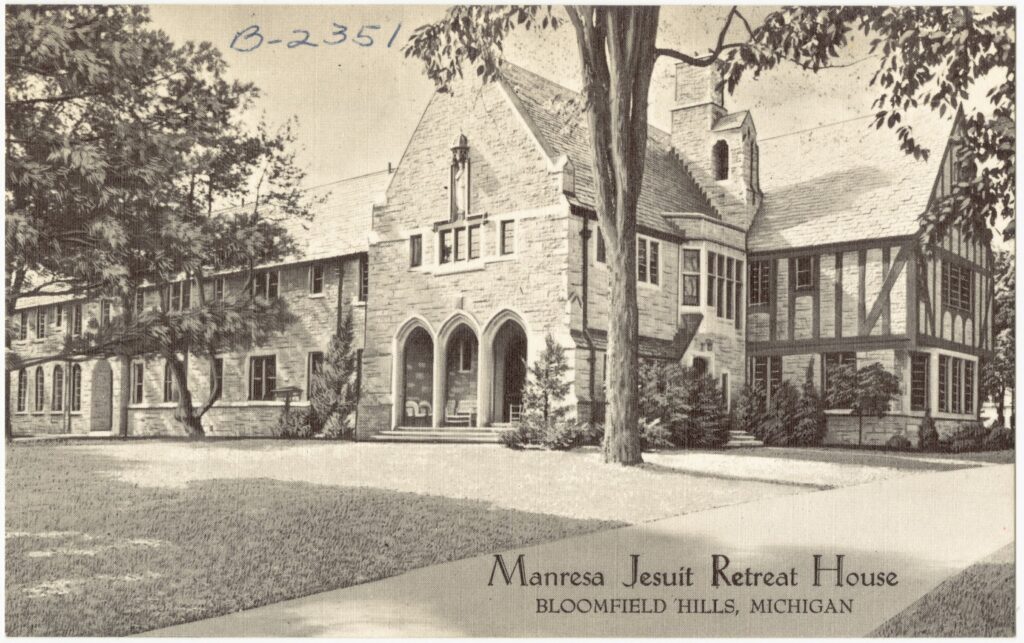
Then there's the housing itself. Large custom homes, historic estates, and heavily wooded lots define the look. The city is known less for a downtown and more for what sits behind the trees.
Quiet. The population density runs under 900 people per square mile, so it reads more like a wooded enclave than a typical inner suburb. You drive to most things. There isn't a traditional walkable main street inside the city, so daily errands, restaurants, and shopping usually mean a short trip into neighboring Birmingham or Bloomfield Township.
What you get in exchange is space and privacy. Lots are big, setbacks are deep, and a lot of the appeal is the landscaping and the canopy. Several historic churches add to the architectural character, including Kirk in the Hills, Christ Church Cranbrook, and St. Hugo of the Hills. It's a community that prizes the residential side of life over the commercial one.

Bloomfield Hills, by the numbers

median sale price
$645K
avg days on market
24
price yoy
-11.0%
active listings
158
Prices here vary more than the median suggests, because lot size, school boundary, and architecture move the number a lot from one street to the next. A median is a starting point, not an answer for your specific home. If you want a real number, we'll pull recent comparable sales near your address and walk you through what they mean. It's a free, comp-based valuation done by a person, not an automated estimate.

Getting around

Getting around
Woodward Avenue (M-1) is the spine, running diagonally through the city and connecting it straight down into Detroit. Telegraph Road (US-24) carries north-south traffic on the west side and is where a number of office addresses sit. For the regional commute, I-75 runs to the east through Troy, and Long Lake, Lone Pine, and Square Lake roads handle east-west movement. Downtown Detroit is roughly 20 miles southeast, generally 30 to 40 minutes depending on traffic. There's no rail stop in the city, so this is a car-first community. Major hospital systems and the Troy and Auburn Hills employment corridors are a short drive away.

Things to do in Bloomfield Hills

Tour Cranbrook House and Gardens, or catch an exhibit at the Cranbrook Art Museum or the Cranbrook Institute of Science.
Walk the grounds at Kirk in the Hills, a Presbyterian church modeled on a Scottish abbey.
Drive the Woodward corridor down toward Birmingham for restaurants and shopping, a few minutes south.
Take in the architecture of Christ Church Cranbrook and St. Hugo of the Hills, both built in the late 1920s and 1930s.

Is Bloomfield Hills a good place to buy?

For the right buyer, yes. You get one of the state's top school districts, real privacy, and homes with character and land that you can't replicate in a newer subdivision. That's the upside. The honest tradeoff: this is a car-dependent city with no walkable downtown of its own, higher price points than most of Oakland County, and an older estate housing stock that can carry real maintenance and update costs. If walkability and a lower entry price are your priorities, neighboring Birmingham or Royal Oak may fit better. If space, schools, and quiet are what you're after, Bloomfield Hills is hard to beat.
The homes
The housing stock skews large, custom, and estate-style, set on wooded lots. You'll find historic homes tied to the city's early-20th-century growth alongside newer custom builds, plus mid-century houses on the bigger parcels. This is not a subdivision-of-identical-colonials market. Lot size, privacy, and architecture drive a lot of the value, and two homes on the same street can price very differently based on the land and the build. Condos and smaller homes exist but are the exception, not the rule.
Schools
Most of Bloomfield Hills falls inside Bloomfield Hills Schools. A southern portion of the city is served by Birmingham City School District instead, so the boundary matters depending on the address.
Resources

Top questions, answered

The stuff people actually ask us. (No fine print.)

ReadyGet started

Thinking about a move in Bloomfield Hills?

Work with one of our agents who sells Bloomfield Hills every week. Get a free home value or see what is on the market.