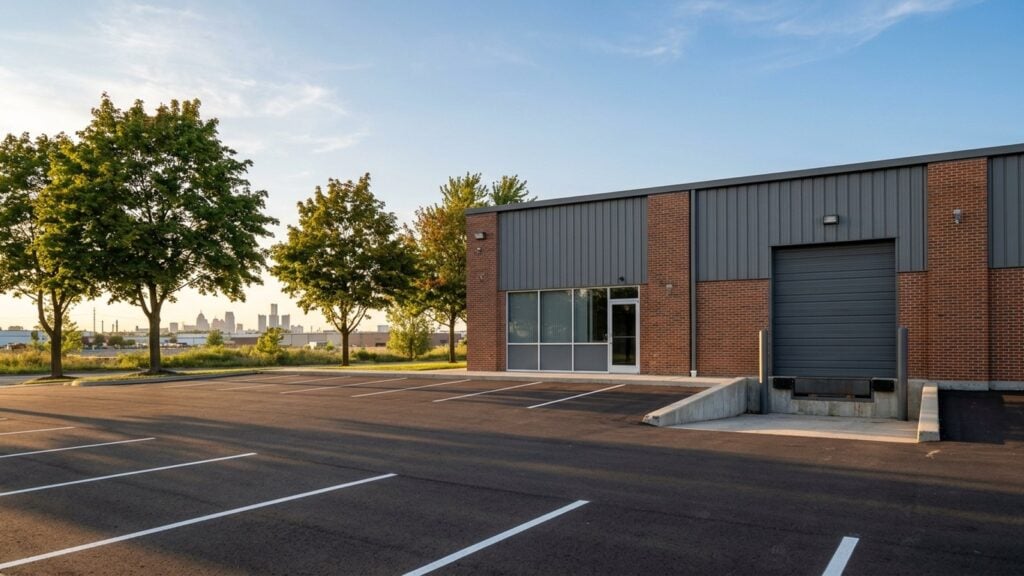
Plan on 3% to 6% of the sale price in broker commission, plus closing costs that usually land between 1% and 3%. The seller pays the commission, and it covers both sides of the deal. On a $1.2 million industrial building in Warren, that is roughly $36,000 to $72,000 in commission and another $12,000 to $36,000 in everything else.
That is a wide range, and the spread is not random. Deal size moves it more than anything else. Here is how the number actually gets set, what else comes out of your proceeds, and the questions worth asking before you sign anything.
How much is commercial real estate commission?
Commercial commission runs 3% to 6% of the sale price and is fully negotiable. There is no standard rate and never has been.
The pattern is straightforward: smaller deals carry a higher percentage, larger deals carry a lower one.
| Sale price | Typical commission | On that deal |
|---|---|---|
| Under $1 million | 5% to 6% | $50,000 on a $1M sale at 5% |
| $1M to $3 million | 4% to 5% | $90,000 on a $2M sale at 4.5% |
| $3M to $5 million | 3% to 4% | $140,000 on a $4M sale at 3.5% |
| Over $5 million | 2% to 4% | $240,000 on an $8M sale at 3% |
Why the slide? The work of selling a $900,000 retail strip and a $9 million distribution center is not ten times different, but the check would be. So the percentage comes down as the number goes up.
Two more things that move it:
- Property type. A single-tenant net-leased building with clean financials moves faster than a half-vacant office park. Harder assets carry higher rates because they take longer and cost more to market.
- Whether the fee is split. The seller pays one commission and the listing broker splits it with whoever brings the buyer. If your broker also finds the buyer, that is not automatically a discount, but it is a fair thing to raise before you sign.
What are the other costs of selling commercial property?
Commission is the biggest line, not the only one. Budget 1% to 3% of the sale price for the rest.
| Cost | Who usually pays | Rough range |
|---|---|---|
| Title insurance (owner’s policy) | Seller, by Michigan custom | about $4.15 per $1,000 |
| Title and escrow fees | Split | $1,500 to $5,000 |
| Michigan real estate transfer tax | Seller | $8.60 per $1,000 of value |
| Recording fees | Seller | $30 to $200 |
| Attorney review | Seller | low thousands, more if heavily negotiated |
| Environmental assessment (Phase I) | Often seller, to pre-clear | $2,000 to $4,500 |
| Survey (ALTA) | Often seller | $3,000 to $8,000 |
| Prorated property taxes | Seller, through closing date | Varies |
The Michigan transfer tax is the one people forget. The state tax is $3.75 per $500 of value, which works out to $7.50 per $1,000, and the county adds $1.10 per $1,000. Combined, that is $8.60 per $1,000, or $10,320 on a $1.2 million sale. It comes off the top and it is the seller’s, not the buyer’s.
Two of those deserve a note.
Title insurance is cheaper here than people expect. Michigan runs about $4.15 per $1,000 of price, so roughly $4,980 on a $1.2 million sale. By Michigan custom the seller buys the owner’s policy and the buyer buys the lender’s policy.
Phase I environmental is the one people underestimate. A standard commercial parcel runs $2,000 to $4,500 nationally, and the Midwest tends to come in below that average. Sites with a history that worries a lender, former gas stations, dry cleaners, long-running industrial use, run higher. On industrial and older commercial property a buyer’s lender will require one. Ordering it yourself before you list means you find the problem on your schedule instead of theirs, mid-escrow, with a signed purchase agreement and leverage on the other side of the table.
The ALTA survey range moved. Standard commercial work runs $3,000 to $8,000 under the 2026 ALTA/NSPS standards. Large or complicated sites can pass $15,000.
What is a net sheet, and why ask for one first?
A net sheet is a one-page estimate of what actually lands in your account at closing: sale price, minus commission, minus every cost above, minus the mortgage payoff.
Ask for one before you list, not after you have an offer. The list price that clears your loan and the list price that looks good in a headline are frequently not the same number, and you want to know that in advance.
A quick version on a $1.2 million sale:
| Line | Amount |
|---|---|
| Sale price | $1,200,000 |
| Commission at 5% | ($60,000) |
| Michigan transfer tax at $8.60 per $1,000 | ($10,320) |
| Owner’s title policy at $4.15 per $1,000 | ($4,980) |
| Escrow and recording | ($3,500) |
| Attorney | ($4,000) |
| Phase I ($3,000) + ALTA survey ($5,500) | ($8,500) |
| Estimated net before payoff | $1,108,700 |
That is about 92.4% of the sale price. Whatever remains on the mortgage comes out of that.
Commission is $60,000 of the $91,300 total, so about two thirds. Everything else together is roughly 2.6% of the price, which is why the 1% to 3% rule of thumb holds up.
What questions should you ask before listing commercial property?
Ask these before you sign a listing agreement. The answers tell you more than any pitch deck.
- What is your commission, and what does it cover? Get marketing, photography, CoStar and LoopNet syndication, and broker outreach named explicitly. “Full service” is not a list.
- How long is the listing term, and can I exit? Commercial listings often run 6 to 12 months. Ask what happens if nothing moves in 90 days.
- What is the protection period after expiration? Most agreements say that if a buyer the broker introduced closes within 90 to 180 days after the listing ends, the commission is still owed. That is normal. Just know the window.
- How will you price it? You want to hear income approach, sales comparison, and cost approach, not a gut number. We break those three down in our guide to determining commercial property value.
- What comparable deals have you closed in this asset class? Retail, industrial, office, and multifamily are different businesses. Closed comps in your type beat a big total volume number.
- Who actually works my listing? On teams, the person who pitches is not always the person who answers the phone in month four. Fair question, ask it early.
- What do you need from me, and when? Rent roll, trailing 12 months of operating statements, tax bills, service contracts, leases, environmental history. Gathering that takes weeks. Start before you list.
How do you vet a commercial listing before you buy it?
Same coin, other side. If you are the buyer, these are the documents that tell you whether the number is real.
- Rent roll and lease abstracts. Who is in the building, what do they pay, when does each lease end, and are there options to renew at below-market rents? A 6% cap rate with three leases expiring next year is not really a 6% cap rate.
- Trailing 12 months of operating statements. Compare them to the pro forma. Pro forma is a projection. Trailing 12 is what happened.
- Tax bills, not tax estimates. In Michigan, a sale can uncap the taxable value under Proposal A, which means your tax bill after closing may be materially higher than the seller’s. Model the uncapped number.
- Phase I environmental. Non-negotiable on industrial and most older commercial.
- Zoning and certificate of occupancy. Confirm the use you intend is the use that is permitted, in writing, from the municipality.
- Deferred maintenance. Roof age, HVAC age, parking lot condition, electrical service. These are six-figure line items on commercial buildings, not weekend projects.
How we handle commercial deals
We have sold thousands of properties across Metro Detroit since 1999, residential and commercial, so we have sat on both sides of this table. Here is how we run it:
- You get a net sheet before you list. Not after an offer comes in. You should know your walk-away number before the sign goes up.
- The commission is one number, agreed up front, in writing. No sliding scale you find out about at closing.
- We tell you what the property is worth, not what you want to hear. Sometimes that is a shorter conversation than people expect. It is still the right one.
Selling a building is not the same as selling a house, and it should not be priced or marketed like one. Talk to an agent and we will put together a net sheet on your property, no cost and no obligation. If you are on the sell side of a residence instead, start on our selling page.
Frequently asked questions
How much is commission on commercial real estate?
Commercial real estate commission typically runs 3% to 6% of the sale price and is paid by the seller. Smaller deals under $1 million usually land at 5% to 6%, while deals over $5 million often fall to 2% to 4%. The rate is fully negotiable and moves with deal size, property type, and how hard the asset is to market.
Who pays the commission when selling commercial property?
The seller pays the commission at closing. The listing broker then splits it with the broker who brings the buyer. This differs from residential real estate, where each side’s fee has been negotiated separately since the NAR settlement took effect in August 2024.
What are the closing costs when selling commercial property in Michigan?
Beyond commission, expect 1% to 3% of the sale price. That covers Michigan’s real estate transfer tax of $8.60 per $1,000, the owner’s title policy at roughly $4.15 per $1,000, escrow and recording fees, attorney review in the low thousands, and often a Phase I environmental assessment at $2,000 to $4,500 and an ALTA survey at $3,000 to $8,000. Property taxes are prorated through the closing date.
What is the Michigan transfer tax on commercial property?
Michigan charges a state transfer tax of $3.75 per $500 of value ($7.50 per $1,000) plus a county tax of $1.10 per $1,000, for a combined $8.60 per $1,000. On a $1.2 million sale that is $10,320, and it is customarily paid by the seller.
How much does a Phase I environmental site assessment cost?
A standard commercial parcel runs $2,000 to $4,500 nationally, and Midwest pricing tends to fall below that average. Properties with a history that concerns lenders, former gas stations, dry cleaners, or long industrial use, cost more. The report covers a federal, state and local database review, a site inspection, owner interviews, and a written report meeting the ASTM E1527-21 standard.
Do I need a Phase I environmental assessment to sell commercial property?
You are not legally required to order one, but most buyers’ lenders will require it on industrial and older commercial property. Ordering it before you list means any issue surfaces on your timeline rather than mid-escrow, when the buyer holds a signed purchase agreement and the leverage.
What is a protection period in a commercial listing agreement?
It is a window after the listing expires, usually 90 to 180 days, during which the broker still earns a commission if a buyer they introduced closes on the property. It is standard and it protects the broker’s work. Ask for the exact length before you sign.