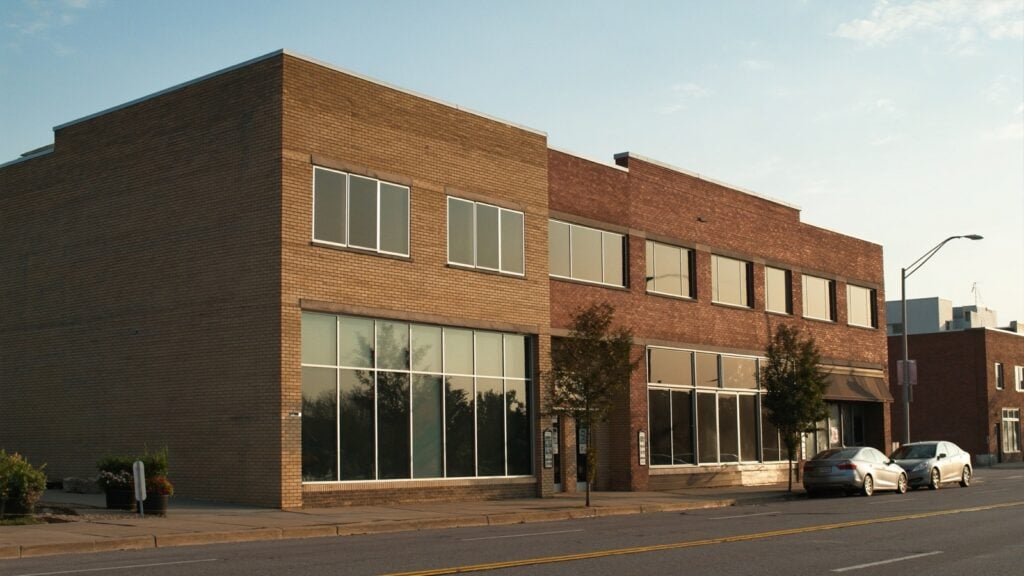
Commercial property value comes down to three appraisal methods: the income (cap rate) approach, the sales comparison approach, and the cost approach. For income-producing property, value is net operating income divided by the market cap rate. Most appraisers use two or three of these together, then reconcile them into one defensible number.
Residential value leans on comparable sales. Commercial value usually leans on the money the building makes. That one shift explains most of what follows.
How is commercial property value calculated?
There is no single formula. A certified appraiser weighs the three approaches below based on the property type, how much income it produces, and how many comparable sales exist. A good appraiser rarely bets on one method alone. They run at least two, then reconcile.
Here is how the three approaches stack up:
| Approach | Formula (plain version) | Best used for |
|---|---|---|
| Income (cap rate) | Net operating income ÷ cap rate | Office, retail, multifamily, anything leased for income |
| Sales comparison | Adjusted price of recent comparable sales | Property types with lots of recent sales nearby |
| Cost | Replacement cost, minus depreciation, plus land | New construction and special-use (schools, churches, medical) |
What is the income (cap rate) approach?
This is the one most commercial buyers care about, because it values the building on the cash it produces. You take the net operating income (NOI), which is annual rental income minus operating expenses (before your mortgage), and divide it by the market cap rate.
The math: NOI ÷ cap rate = value.
A building throwing off $200,000 in NOI, valued at a 7% cap rate, is worth about $2.86 million. Same building at a 6% cap rate is worth about $3.33 million. Nothing about the property changed. The market’s required return did. That is why cap rates matter as much as the rent roll.
The income approach fits office, retail, and multifamily best, because those assets exist to produce income.
What is the sales comparison approach?
Same idea as valuing a house, harder to run. You find recent sales of similar commercial properties and adjust for the differences: location, lot size, building features, age, condition, and how usable the space is.
The catch is that commercial buildings are less alike than houses, and sales are thinner. The approach works when there are enough genuine comps to draw from. In a market with few recent sales of a given property type, appraisers lean harder on the income approach instead.
What is the cost approach?
Here you value the land, then add what it would cost to rebuild the structure today, minus depreciation for age and wear. Land plus (replacement cost minus depreciation) equals value.
The cost approach shines on new construction, where depreciation is minimal, and on special-use property that rarely sells and makes little income, like schools, churches, and some medical or municipal buildings. For those, it is often the only method that produces a usable number.
What is a cap rate, and what is a good one in 2026?
A capitalization rate is the unleveraged annual return a property produces, expressed as a percentage of its price. It is what you would earn if you paid all cash. The formula runs both directions: NOI ÷ value = cap rate, and NOI ÷ cap rate = value.
Lower cap rate, higher price and lower yield (the market sees less risk). Higher cap rate, lower price and higher yield (more risk, or a weaker location). Most commercial investors look for cap rates between 4% and 10%, depending on property type and location.
National cap rate ranges by asset class, as of early 2026:
| Asset class | Cap rate range (2026) |
|---|---|
| Trophy multifamily / net lease | 4.5% to 6.0% |
| Industrial (big box) | 5.5% to 7.0% |
| Class A office | 6.0% to 8.0% |
| Class B office | 8.5% to 11.0% |
| Anchored retail centers | 6.5% to 8.0% |
CBRE expects cap rates for most property types to compress by roughly 5 to 15 basis points through 2026, with the best-quality assets tightening most.
Metro Detroit runs a little wider than the national bands, which is normal for a Midwest market. Class A trophy office here trades around 7.0% to 8.0%, stabilized Class B suburban office around 8.5% to 10.5%, and grocery-anchored retail centers around 6.0% to 7.0%. Industrial stays the tightest story locally, with vacancy around 4.4% in Q1 2026 as the market keeps absorbing space.
Do you need a licensed appraiser in Michigan?
For a formal valuation tied to a loan, sale, or dispute, yes. In Michigan, a certified general appraiser is the license that can value any commercial property, at any value or complexity, in federally related transactions. A broker’s opinion of value is useful for pricing and strategy, but it is not a substitute for that appraisal when a lender or court needs one.
How we value commercial property at Jim Shaffer & Associates
Straight talk: we are a residential team first. We have sold thousands of houses across Royal Oak, Ferndale, Birmingham, and Oakland County since 1999, and that is the core of what we do ($2 billion in career sales and counting).
Plenty of the people we work with also own commercial property, so here is how we help. We run the NOI, pull the comparable sales that exist, and estimate where a building lands against current Metro Detroit cap rates. When a deal calls for a formal number, for financing, a sale, or a tax appeal, we bring in a certified general appraiser and coordinate the process with you. No guessing, no inflated figures to win the listing.
If you own commercial property here and want an honest read on what it is worth, talk to us. We will tell you what we know, and be clear about where a licensed appraiser needs to take it from there.
Frequently asked questions
How do you determine the value of a commercial property?
Commercial value is set using three appraisal methods: the income (cap rate) approach, the sales comparison approach, and the cost approach. Income property is usually valued as net operating income divided by the market cap rate. Appraisers typically run two or three methods, then reconcile them into one figure.
How is commercial real estate valued differently from a house?
Homes are valued mainly on comparable sales. Commercial property is usually valued on the income it produces, using the cap rate approach. Because commercial buildings are less alike and sell less often, appraisers rely more on net operating income and less on direct comparisons than they do with houses.
What is a cap rate?
A cap rate is the unleveraged annual return a property produces as a percentage of its price, or what you would earn paying all cash. The formula is net operating income divided by value. A lower cap rate means a higher price and lower risk. A higher cap rate means a lower price and more risk.
What is a good cap rate in 2026?
Most commercial investors target cap rates between 4% and 10%, depending on property type and location. In early 2026, Class A office runs roughly 6% to 8% nationally, industrial 5.5% to 7%, and anchored retail 6.5% to 8%. Metro Detroit tends to run slightly wider than these national bands.
Do I need a licensed appraiser to value commercial property in Michigan?
For a formal valuation tied to a loan, sale, or dispute, yes. Michigan requires a certified general appraiser to appraise commercial property in federally related transactions. A broker’s opinion of value helps with pricing and strategy, but it does not replace a licensed appraisal when a lender or court needs one.